
Beyond the Barrels: 5 Surprising Signals
Published:
The global energy industry is navigating an era of profound transformation, defined by a complex mix of market volatility, geopolitical shifts, and the urgent imperatives of the energy transition.
Beyond the Barrels: 5 Surprising Signals from PETRONAS’s 2026-2028 Outlook
Disclaimer
This article is written in an individual capacity. The views expressed are personal and do not represent, nor are they intended to represent, the interests, positions, or opinions of any company or organization.
In this climate of heightened uncertainty, strategic clarity is the most valuable commodity. For industry players in Malaysia and the broader region, that clarity has arrived in the form of a crucial document.
The PETRONAS Activity Outlook 2026-2028 is far more than a simple forecast. It is a strategic blueprint that provides unambiguous market signals that will separate the winners from the laggards in the coming decade. While many reports focus on broad trends, the PETRONAS outlook details a company—and an entire ecosystem—in the midst of an ambitious, deliberate evolution, providing concrete targets and new initiatives that signal fundamental shifts in priorities and expectations.
This article distills the report into the five most impactful and counter-intuitive takeaways. For Oil and Gas Services and Equipment (OGSE) players and stakeholders, understanding these signals is not just beneficial—it is essential for building a competitive strategy to survive and thrive in the years ahead.
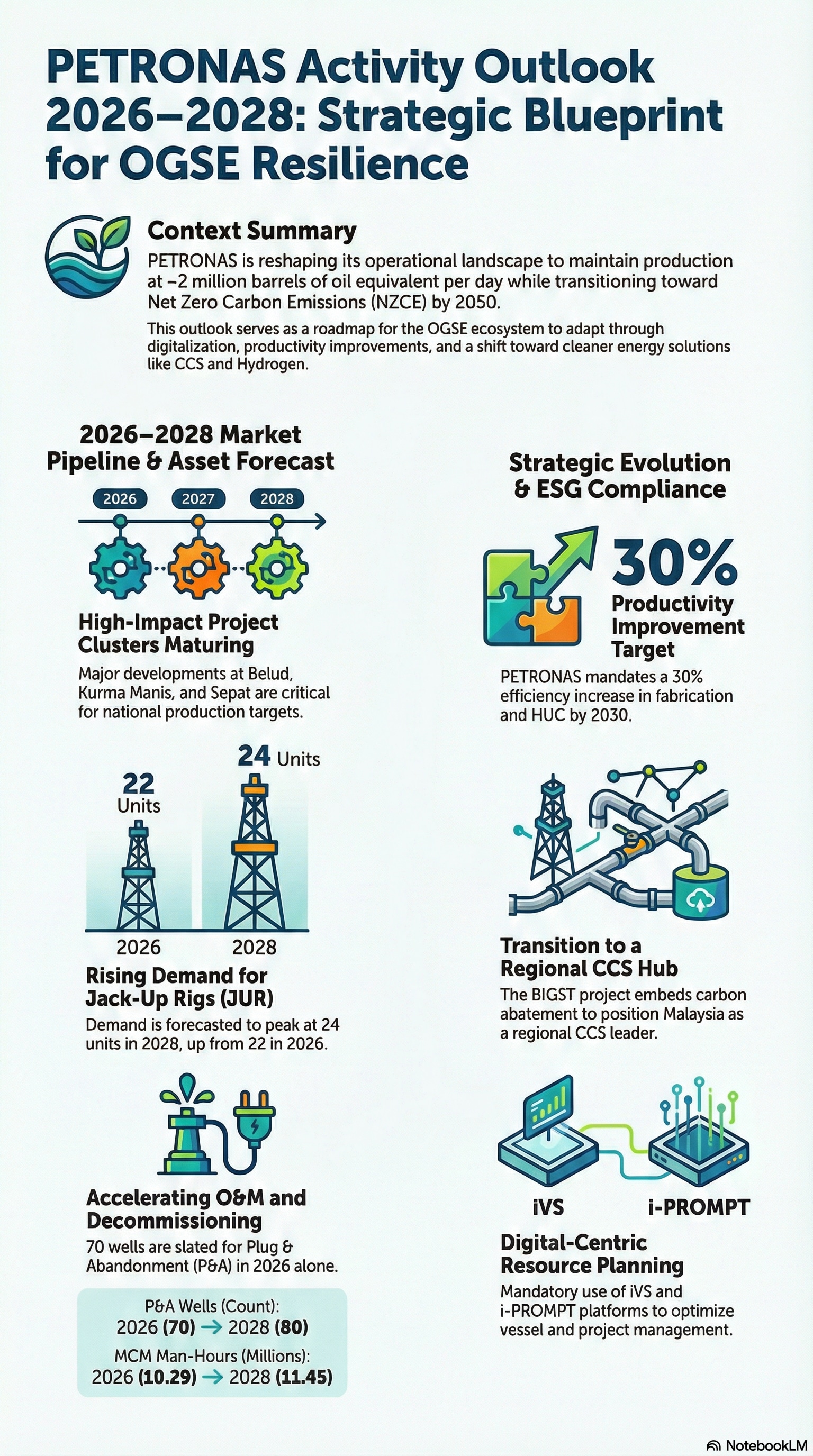
1. The Mission: Become a ‘Regional Top Quartile’ Performer by 2030
PETRONAS’s CAPE Masterplan 2030 is not corporate jargon; it is a non-negotiable demand for radical operational transformation across its entire value chain. This initiative moves beyond incremental gains, setting aggressive, measurable targets designed to elevate Malaysia’s project delivery capabilities to world-class standards.
The plan’s key strategic goals include:
- Achieving a 50-month cycle from discovery to monetisation, a significant acceleration of project timelines.
- Targeting a 30% productivity improvement by 2030 for Malaysian fabrication yards under the Malaysia Yard Productivity Target (MYPT).
- Driving a 30% improvement in performance, productivity, and cost efficiency for Hook-Up and Commissioning and Modification, Construction and Maintenance (HUC-MCM) contractors.
For OGSE players, the message is stark: this is the new cost of doing business with PETRONAS. Companies that fail to overhaul their operations, aggressively digitize processes, and embed automation to meet these new benchmarks will be marginalized in future contracts. The era of incremental improvement is over; a step-change in efficiency is now the minimum requirement for partnership.
2. The War for Talent is Being Fought in Academies, Not Just Boardrooms
While many organizations issue high-level statements about talent, PETRONAS is executing highly specific, ground-up initiatives to forge a future-ready workforce. This is a critical competitive signal, revealing precisely where the company anticipates future skill gaps and where it is placing its strategic bets.
Key talent development initiatives include:
- The establishment of the Hydraulic Workover Unit (HWU) Academy under Malaysia Petroleum Management (MPM) to create a sustainable talent pipeline for the growing field of well decommissioning.
- A partnership with the Malaysia Offshore Support Vessel Owners’ Association (MOSVA) to launch the Seafarer Junior Officer Competency and Development Handbook, designed to fast-track career progression for local seafarers.
- The formalization of five MoUs with leading contractors to create structured On-the-Job Training (OJT) pathways for critical trades like riggers, welders, and scaffolders.
This strategic building of niche capabilities should serve as a blueprint for the entire ecosystem. The critical question for every OGSE leader is: If PETRONAS is building an academy for decommissioning, where is your company’s equivalent talent pipeline? Are you a passive observer of this workforce transformation, or an active participant in building the skills that will define the next decade of projects?
3. The ‘Energy Superstore’ is More Than a Slogan—It’s a Mandate
PETRONAS has articulated a bold vision to move beyond its traditional identity and become a fully integrated energy provider. This is not a soft aspiration but a core strategic mandate with a hard financial target that will fundamentally reshape the supply chain.
The ambition is captured perfectly in this statement from the Vice President, Group Procurement:
By 2035, PETRONAS aspires to operate as an integrated energy hub, offering a comprehensive portfolio spanning oil and gas, renewables, hydrogen, carbon capture and storage (CCS), and green mobility.
Underpinning this vision is a concrete target that directly impacts every OGSE player: the goal of achieving 25 per cent of OGSE revenue from non-oil and gas sources by 2030.
This sends an unambiguous signal. PETRONAS is not looking for vague ESG commitments; it is seeking partners with demonstrable, revenue-generating capabilities in these new energy verticals. The analysis must challenge every OGSE business: Which of these verticals—renewables, hydrogen, CCS, or green mobility—have you invested in, and what is your credible plan to generate substantial revenue from them by 2030?
4. PETRONAS Isn’t Just Building Tech; It’s Building an Innovation Marketplace
PETRONAS is strategically pivoting from a closed innovation model to an open one, deliberately bypassing traditional procurement pathways in favor of a meritocracy of ideas. This is a double-edged sword for the supply chain, creating both disruptive threats and unprecedented opportunities.
The key platforms driving this change are:
- Innovation Gateway @ PETRONAS (iG@P): A technology marketplace connecting OGSE providers and their solutions directly with PETRONAS’s operational needs.
- FutureTech: A start-up accelerator focused on identifying and nurturing disruptive technologies.
The scale of this shift is significant, and the commitment is clear:
- iG@P has already engaged over 4,000 external participants and made over 600 solutions available for use.
- FutureTech has supported more than 80 start-ups through four cohorts, backed by a network of over 29 corporate and ecosystem partners.
This move represents a direct threat to established, incumbent players who are slow to innovate or rely on legacy relationships. Simultaneously, it creates a massive opportunity for smaller, agile tech firms to compete on the strength of their solutions. PETRONAS is disrupting the “old guard” by leveraging the entire market’s ingenuity, signaling that the best idea—not the oldest relationship—will win.
5. Counter-Intuitively, the Core O&G Business is Booming
Amid the intense focus on the energy transition, the PETRONAS outlook reveals a powerful counter-narrative: the scale of traditional oil and gas activity is not just stable, it is immense and growing in key areas.
The 2026-2028 forecast substantiates this with a tidal wave of activity:
- Drilling Rigs: A steady demand is forecast, with requirements for 22 Jack-up Rigs in 2026 rising to 24 in 2028.
- Well Abandonments (P&A): Decommissioning activity is set to increase significantly, rising from 63 wells in 2025 to a sustained level of 80 wells per year in 2027 and 2028.
- Offshore Fabrication: A consistent pipeline of projects is planned, with 10 fixed structures scheduled for 2026 and another 8 for 2027.
- Production Target: This activity supports the overarching goal to sustain domestic production at close to two million barrels of oil equivalent per day.
This is the most critical strategic synthesis for OGSE players. The immense activity and cash flow from the core O&G business is the engine funding the energy transition described earlier. It is not a separate track; it is the enabler. The insight is clear: successful OGSEs must prove they can optimize costs and deliver flawlessly on the core business to earn the right to partner on the new energy ventures of tomorrow.
Conclusion: A Dual Path to the Future
The PETRONAS Activity Outlook 2026-2028 paints a clear picture of a dual strategy in action. The company is aggressively optimizing its core oil and gas operations with an uncompromising focus on efficiency, while systematically and strategically building the new energy businesses, talent pipelines, and innovation ecosystems of the future.
For OGSE players, navigating this dual path is not just a challenge; it is a matter of survival. In this new landscape, operational excellence in the old world is the price of admission, but strategic partnership in the new world is the only path to long-term relevance. The path forward is not about choosing one or the other, but mastering both.
As PETRONAS redefines itself as an integrated ‘energy superstore,’ how will your business evolve from bein g a simple supplier to becoming a true strategic partner in this new ecosystem?
References
- [1] PETRONAS Activity Outlook 2026-2028: Strengthening Energy Ecosystem for Malaysia’s Energy Transition: https://www.petronas.com/media/media-releases/petronas-activity-outlook-2026-2028-strengthening-energy-ecosystem-malaysias